
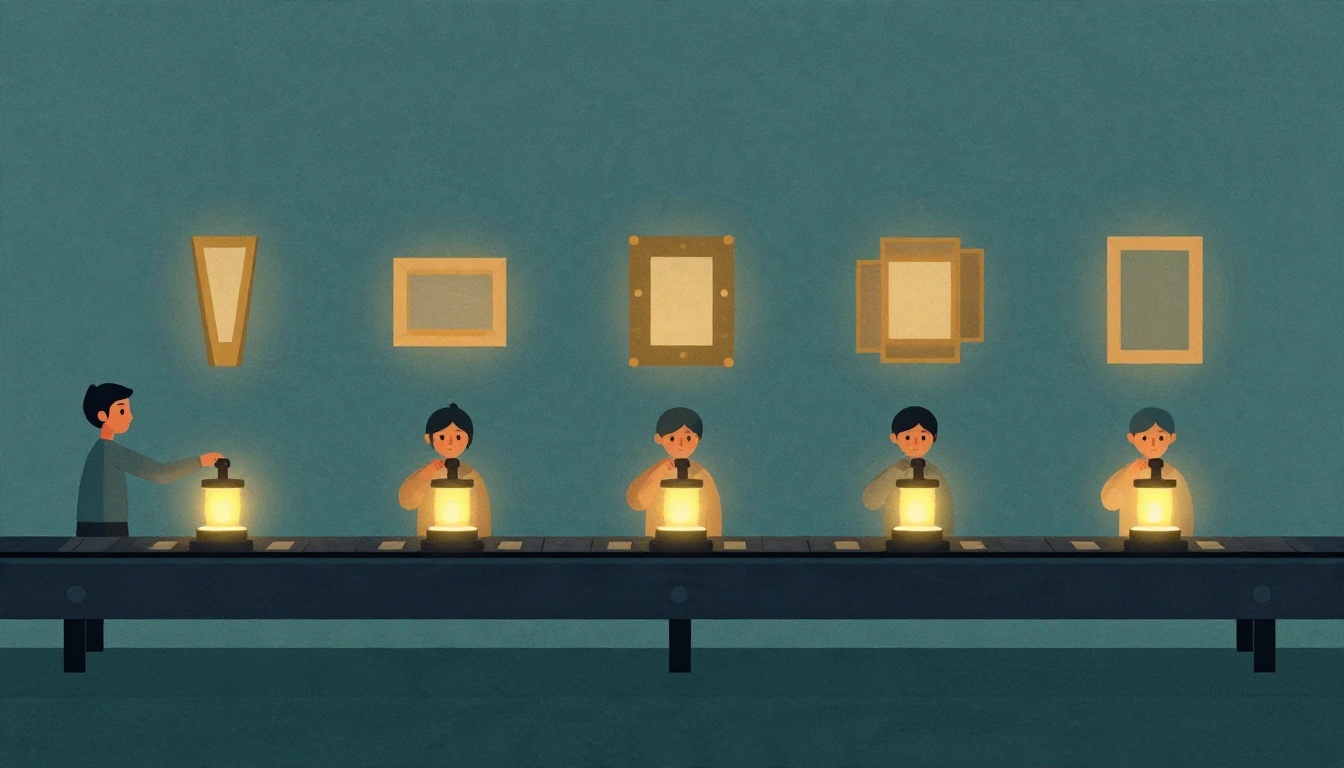
AI footage rarely fails at the end. It fails at the prompt, the keyframe, the motion pass, or the label render—and a single review at delivery only sees the combined, harder-to-trace result. The fix is not more watching; it is a human review gate placed where errors are introduced, with a named owner and a written sign-off.
According to the research, where should quality control checks for AI-generated content be placed?
Select one answer.
Why one final review is not enough
Quality control for AI-generated content works best as a risk-based system with checks placed where errors are introduced, not as a review at the end (Lifewood). Generative video can render a label wrong or invent a detail that never existed, so the review layer between generation and delivery is what makes the footage safe to publish at all (Humanreel).
That means your gate has to catch hallucination, brand safety, label and colour accuracy, and visual artefacts before a file reaches an approver—not after a customer flags it.
Build the gate in three stages
Small teams get the most reliable results from a sequential, three-tiered pipeline—Reference, Motion, and Final-Take—under a single creative decision owner (Montagea). No one generates high-resolution video until the underlying assets and motion are locked.
- Reference and keyframe gate. Lock character design, costume, lighting, and composition as static frames. The creative director signs off before any video render. This is where you stop creative drift and wasted credits.
- Motion and physics gate. Review the generated motion for natural movement, temporal consistency, and lip-sync before upscaling. Human reviewers are trained to spot subtle motion issues and temporal inconsistencies that automated systems miss (iMerit).
- Final-take gate. Check the assembled cut against the brief: label accuracy, colour match to the real product, brand safety, and audio sync. Only cleared files move to client approval.
Separate automated checks from human judgment
Anything expressible as a rule should be automated: banned terms, missing disclaimers, file specs, subtitle timing, and duplicate passages. Human reviewers handle what cannot be stated as a rule—factual accuracy, brand fit, cultural reading, and whether the asset serves its purpose (Lifewood).
Modern AI can already evaluate whether video meets basic technical standards for brightness, contrast, sharpness, and colour without human assessment (Joyspace). Let it do that, and reserve your reviewers for the judgment calls.
Write the gate down
A gate only works if it is documented. Define five things: the stages a cut passes through, the reviewers empowered at each stage, what each reviewer owns, the version each decision attaches to, and the event that counts as approval (Frooty).
Use this checklist before you call the gate live:
- One named decision owner with veto power per stage
- A written checklist of what each gate checks
- Version numbers on every file that enters review
- A logged approve/reject event, not a Slack thumbs-up
- A defect log recording class, severity, and origin
- A revision loop built into the schedule, not billed as extra
Measure the gate itself
Track defect escape rate—the share of defects found only after delivery. It is the one metric that measures the review system rather than the content it reviewed (Lifewood). If the rate climbs, your gate is in the wrong place, not your reviewers.
How the Featured Expert Can Help
Parallax Black is a Dallas-based boutique AI video production studio led by visual artist Adam Norton, blending human creative direction with an AI-accelerated pipeline for brand films and social content. The studio emphasizes character consistency and professional finishing, and its human-directed workflow is built to keep AI-generated work from looking algorithmic. You can learn more at parallaxblack.com.
Quiz
Test what you have learned about where a human review gate belongs.