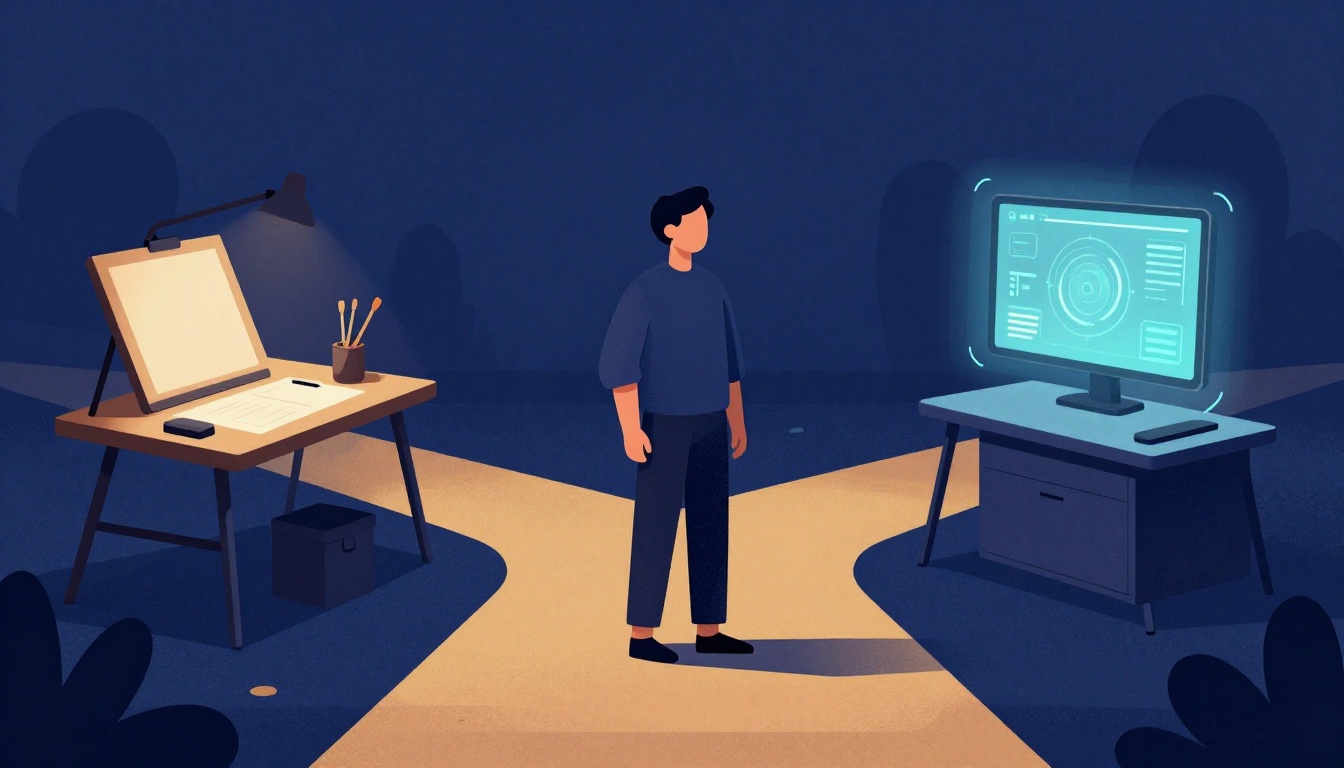
You have a shot that needs visual effects. The old way means weeks of rotoscoping, compositing, and render time. The new way means typing a prompt and waiting seconds. But here's the catch: one delivers pixel-perfect control, and the other delivers speed. Choosing wrong costs you either a blown deadline or a shot that looks off.
The question isn't which technology is better. It's which one fits the specific job in front of you.
What percentage of production costs can AI VFX tools eliminate compared to traditional pipelines?
Select one answer.
The real difference: control versus speed
Traditional VFX is a craft built on precision. Every flame, every particle, every edge of a composite is hand-built by an artist using tools like After Effects, Nuke, or Houdini. That level of control comes at a cost. A single high-end VFX shot can run $20,000 to $40,000 and take weeks to complete, according to industry breakdowns from ActionVFX. The pipeline moves through planning, asset creation, animation, simulation, compositing, and revision cycles that stretch two to six months for a VFX-heavy project.
Generative AI flips that model. Instead of building every element from scratch, AI tools analyze footage and generate effects automatically. Background removal, object tracking, motion effects, and scene enhancements that once required hours of manual work now process in minutes. The VFXAI comparison notes that AI workflows run dramatically faster than traditional methods, compressing what used to take months into hours or days.
The trade-off is real. You trade absolute control for speed and cost efficiency. The trick is knowing when that trade works in your favor.
When traditional VFX still wins
Stick with traditional VFX when the shot demands photorealism that can't be faked. Digital humans, complex physics simulations, and hero product shots where every reflection must be exact still belong in the hands of skilled artists. The VFX Voice roundtable of industry leaders confirms that AI currently augments rather than replaces traditional pipelines for high-end cinematic work. Tasks like motion capture cleanup and rotoscoping are being automated, but the creative direction still requires human judgment.
You should also stay traditional when legal certainty matters. CGI built from scratch carries no copyright ambiguity. AI-generated content, depending on jurisdiction, can raise questions about training data and ownership that risk-averse brands can't afford.
Where generative AI shines
Generative AI excels in three specific scenarios.
First, high-volume content. Marketing teams producing multiple campaign variants, social media clips, or A/B test assets benefit from AI's ability to iterate fast. A single 30-second commercial that would cost $15,000 to $30,000 through traditional VFX can be produced at a fraction of that cost using AI-accelerated workflows.
Second, pre-visualization and mood exploration. Before committing to a full VFX build, AI lets directors and clients explore visual directions in hours instead of weeks. This saves budget for the shots that actually need the full treatment.
Third, standard effects at scale. Background replacement, object removal, basic particle effects, and motion graphics are areas where AI now matches or exceeds manual output for most commercial use cases. The Danthree Studio analysis points out that the most cost-effective solution today is a hybrid workflow that uses CGI as a precision foundation and scales the environment with AI.
The hybrid sweet spot
The smartest teams aren't choosing one or the other. They're building pipelines that use each tool where it belongs. Use traditional VFX for the hero shots that need frame-by-frame control. Use generative AI for backgrounds, environmental extensions, and effects that support the main action. Use AI for rapid iteration during the look-development phase, then lock the final composite with traditional compositing.
This hybrid approach gives you the speed and cost savings of AI without sacrificing the quality that comes from human creative direction. It's the difference between letting AI run the show and using AI as a powerful tool in an experienced artist's hands.
How the Resident Expert Can Help
Deciding when to bring generative AI into your pipeline isn't a theoretical exercise. Every project has different constraints, and the wrong call can waste time or compromise quality. That's where a partner with real production experience makes the difference. Parallax Black is a Dallas-based boutique AI video production studio led by visual artist Adam Norton, who brings 25 years of high-end VFX experience to every project. The studio blends human creative direction with AI-accelerated workflows, ensuring that every shot benefits from both the speed of modern tools and the judgment of seasoned artists. Whether you need a full brand film or guidance on where AI fits your existing pipeline, Parallax Black delivers cinematic results without the traditional overhead.